

Most of what we shoot, we control. The location is booked, the talent is cast, the light is where we put it, and if a take does not work we go again.
Then there are the days where none of that is true. A supporters march before a match is one of them. It happens once, it moves at its own pace, several hundred people are on it and not one of them works for you. There is no second take and there is no stopping to reset.
You plan for coverage, not for shots
On a controlled shoot the plan is a shot list. On a day like this a shot list is close to useless, because the thing you are describing has not happened yet and will not happen the way you imagined.
What you plan instead is coverage. Where the march starts, the route it takes, where it bottlenecks, where the light will be at that hour, and which two or three moments are almost certain to occur even if you cannot know their exact shape. Flags going up. The drum starting. The moment the group rounds a corner and the noise changes.
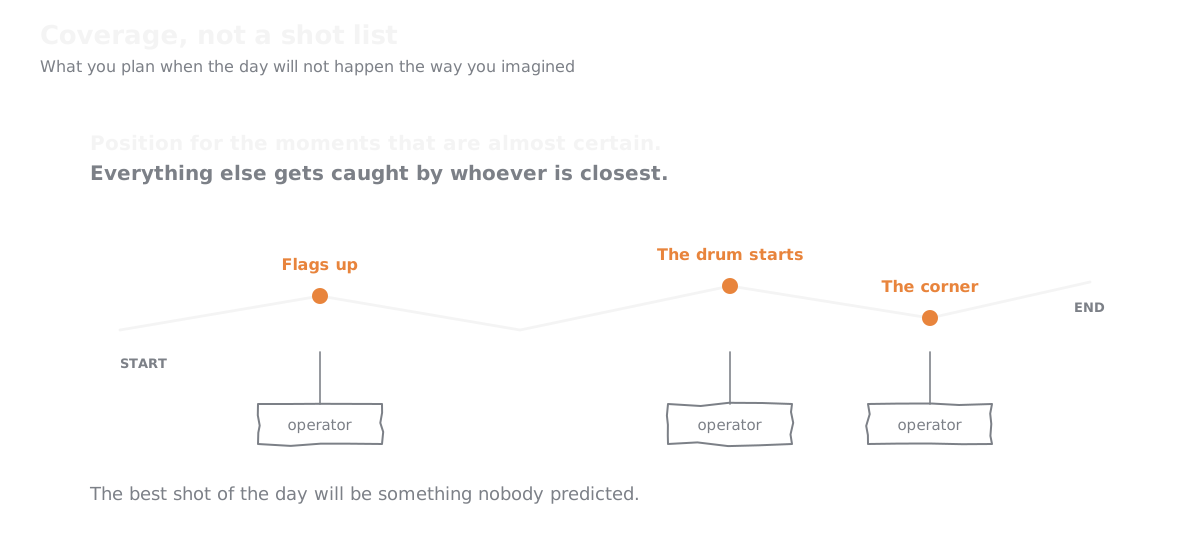
Then you position people to catch those, and you accept that the best shot of the day will be something nobody predicted.
The agreements that have to exist first
None of this works without the unglamorous part being settled days earlier.
Who has authority over the route, which is often not one body. There may be a club, a supporters group, a venue and a city permit involved, and they do not always talk to each other. Someone has to have spoken to all of them.
What you are allowed to film, and where the line sits between a public crowd and a private event. Whether there are people who must not appear, and how you would even know.
Where your crew is permitted to stand, which matters more than it sounds when a few hundred people are moving through a space and a camera operator walking backwards is a genuine hazard.
Getting this agreed early is also what buys you access on the day. A steward who knows who you are lets you through. A steward who does not, quite reasonably, does not.
Operators make the decisions, not the director
The practical consequence is that authority moves. On a normal set the director calls it. In a moving crowd nobody can see enough to call anything, so each operator is making their own decisions about what matters in front of them, in the moment.
That only works if the brief is understood rather than dictated. Everyone needs to know what the film is about and what feeling it is reaching for, because they are each going to encounter something unrepeatable and have about a second to decide whether to follow it.
It is a different skill from executing a shot list well, and it is worth knowing which of the two you are hiring for.
Rigs get smaller, and that is a decision
There is a trade between image quality and mobility and on this kind of day mobility wins almost every time.
A big rig makes beautiful images and cannot move through a crowd, cannot turn quickly, and makes the operator an obstacle in a group of people who are there for their own reasons, not for your film. A lighter build gets into the middle of it and stays with the moment. The footage is marginally less pristine and contains things the other setup would simply have missed.
Weather made that call easier on this one. Umbrellas up, everyone moving, nowhere to put anything on the ground.
Sound is the part that gets underestimated
Everybody plans the picture. Sound on a day like this is harder and matters more.
A crowd is loud, and loud is not the same as usable. The drum that anchors everything is arriving from a different direction every thirty seconds. Anything anyone says to camera is competing with several hundred people who did not agree to be quiet. There is no boom operator’s clean take to fall back on.
So you gather more than you think you need and you gather it in layers. Wide atmosphere from several points along the route, because a crowd sounds different at the front and the back. Close detail on the specific things that carry the feeling, the drum, a chant starting, feet on a metal bridge. And you keep recording through the parts that look like nothing, because the edit will need somewhere to breathe between the big moments.
Almost none of it ends up where it was recorded. It gets rebuilt in post to follow the picture.
The edit is where it becomes a film
You come back with a great deal of material and no structure, because the day did not have one. It had a route.
The work in the edit is finding the shape that was implied but never staged. Usually that means building toward the moment where the crowd behaves as one thing rather than several hundred people, and using the quieter material to make that moment land rather than cutting it all together at the same pitch.
This is also where the coverage discipline pays off. The predicted moments give the edit its spine. The unpredicted ones, the shot nobody planned, are what make it feel like it was actually there.
Why we keep taking these days
Everything about a live event is harder. Less control, no retakes, weather, crowds, permissions, and a schedule dictated by something other than your production.
What you get back is the one thing that cannot be staged. A crowd that would have been there whether the camera came or not reads completely differently from a crowd that was booked, and everybody watching can tell, even if they could not say why.
It is the same reason we keep real production photography on this site rather than anything generated. The work is the proof, and proof has to be real to do its job.
In summary
- On a day you cannot direct, you plan coverage rather than a shot list.
- The permissions and route agreements have to exist days earlier. They are what buys you access on the day.
- Authority moves to the operators, so everyone has to understand the brief rather than follow it.
- Mobility beats image quality when the crowd is moving. A lighter rig gets the shot a bigger one misses.
- Sound is harder than picture, gets gathered in layers, and is rebuilt in the edit to follow the cut.


